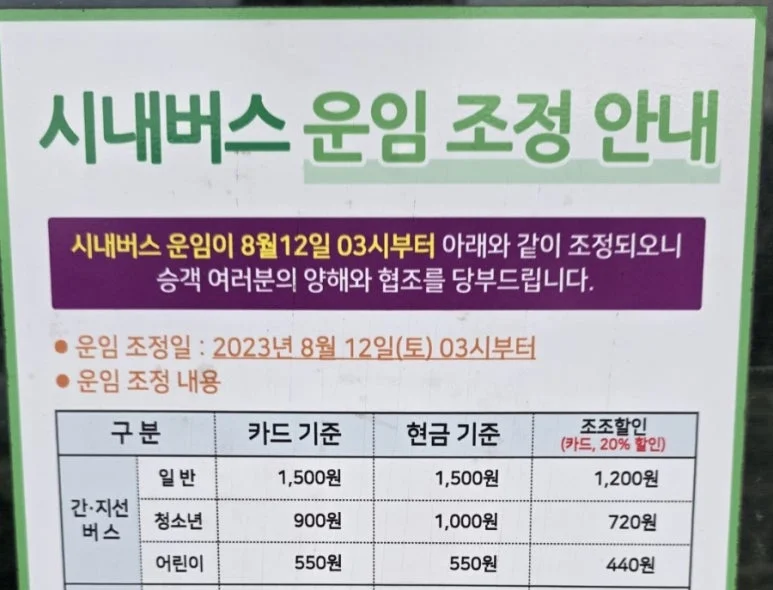
An adult pays ₩1,500 ($1.12) by card and ₩1,500 in cash for a ride on an ordinary Seoul city bus. Those are the fares on a notice posted at a bus stop in Gangnam-gu, a district of Seoul, and they match what Seoul reported to the national public utility charges survey for August 2026. The notice also prices circular, express and night buses, with youth and child fares for each. Seoul’s subway base fare is ₩1,550 by card, and a mid-size taxi starts its meter at ₩4,800. The survey’s cash bus figure is higher than its card figure in every region except Seoul, so outside the capital a transport card is the cheaper way to pay.
The fare notice at a Seoul bus stop
This notice from Seoul’s bus operators’ association was still posted at a bus stop in Gangnam-gu on 12 October 2026. It sets the city bus fares that took effect at 3 a.m. on 12 August 2023, for adults, youths and children, by card, in cash and with the early-morning card discount.
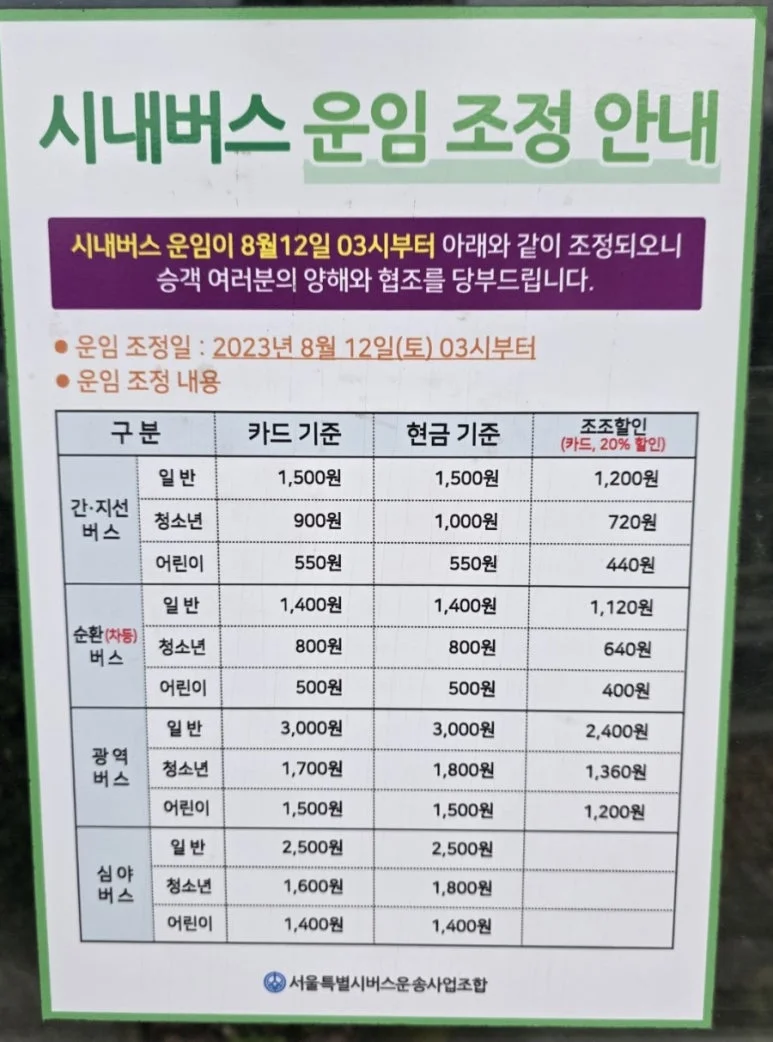
| Bus | Rider | Card | Cash | Early morning (card) |
|---|---|---|---|---|
| Trunk and branch | Adult | ₩1,500 | ₩1,500 | ₩1,200 |
| Trunk and branch | Youth | ₩900 | ₩1,000 | ₩720 |
| Trunk and branch | Child | ₩550 | ₩550 | ₩440 |
| Circular | Adult | ₩1,400 | ₩1,400 | ₩1,120 |
| Circular | Youth | ₩800 | ₩800 | ₩640 |
| Circular | Child | ₩500 | ₩500 | ₩400 |
| Express (gwangyeok) | Adult | ₩3,000 | ₩3,000 | ₩2,400 |
| Express (gwangyeok) | Youth | ₩1,700 | ₩1,800 | ₩1,360 |
| Express (gwangyeok) | Child | ₩1,500 | ₩1,500 | ₩1,200 |
| Night | Adult | ₩2,500 | ₩2,500 | – |
| Night | Youth | ₩1,600 | ₩1,800 | – |
| Night | Child | ₩1,400 | ₩1,400 | – |
An adult pays ₩1,500 on a trunk or branch bus, ₩1,400 on a circular bus, ₩3,000 on an express bus and ₩2,500 on a night bus. For adults and children the card and cash fares are the same.
Youth fares are where cash costs more: ₩900 by card against ₩1,000 in cash on a trunk or branch bus, ₩1,700 against ₩1,800 on an express bus, and ₩1,600 against ₩1,800 at night. Circular buses charge youths the same either way.
The early-morning column is the card fare less 20 percent, as the notice heading says. Night buses have no early-morning fare. The notice does not say which hours count as early morning, and it says nothing about transfers or about neighborhood village buses.
Seoul’s subway and taxi fares beside the bus
We have no posted notice for the subway or for taxis, so the Seoul figures for them come from the survey alone. A subway ride costs ₩1,550 ($1.16) by card and ₩1,650 in cash. Set beside the bus fares of ₩1,500 by card and ₩1,500 in cash, a card saves money on the subway but makes no difference on an adult bus fare.
The survey lists a subway fare for 7 of the 16 regions it covers. By card the lowest is ₩1,250 in Gwangju and the highest is ₩1,600 in Busan, with Seoul between them. In cash the range runs from ₩1,400 in Gwangju to ₩1,700 in Busan and Daegu and Daejeon.
The ₩4,800 ($3.58) for a mid-size Seoul taxi covers the flag-fall only. Distance and time charges are added as the ride goes on, and the survey records none of them, so the fare at the end of a ride will be higher. Across the regions, Gyeonggi and Chungnam report the lowest flag-fall at ₩4,000, and Jeju reports the highest at ₩4,972.
Bus fares the other regions report
Every region except Sejong reports a city bus fare to the same survey. A city reports a single fare, but a province reports one figure that has to cover many towns and counties, and for counties the bus figure is a rural-bus fare. Some figures therefore land on uneven amounts such as ₩1,014, and a provincial figure need not match the fare on any single bus.
By card, the lowest figure is ₩980 ($0.73) in Gyeongbuk (North Gyeongsang Province), and the highest is ₩1,650 ($1.23) in Gangwon. In cash, the lowest is ₩1,014 in Gyeongbuk, and the highest is ₩1,700, reported by Busan and Daegu and Daejeon and Gangwon.
Against Seoul’s ₩1,500 by card, Busan reports ₩1,550 and ₩1,700 in cash, and Incheon ₩1,473 and ₩1,573. Gwangju reports ₩1,250 by card, Daegu ₩1,500, Daejeon ₩1,500 and Ulsan ₩1,500. On Jeju the card figure is ₩1,125 and the cash figure ₩1,183.
| Fare | Lowest | Highest | Difference |
|---|---|---|---|
| Subway, card | ₩1,250 (Gwangju) | ₩1,600 (Busan) | +28.0% |
| Subway, cash | ₩1,400 (Gwangju) | ₩1,700 (Busan and Daegu and Daejeon) | +21.4% |
| City bus, card | ₩980 (Gyeongbuk) | ₩1,650 (Gangwon) | +68.4% |
| City bus, cash | ₩1,014 (Gyeongbuk) | ₩1,700 (Busan and Daegu and Daejeon and Gangwon) | +67.7% |
| Taxi, base fare | ₩4,000 (Gyeonggi and Chungnam) | ₩4,972 (Jeju) | +24.3% |
These are the official charges each region reported to the survey; they are not built for comparing one region with another, and the figures are provisional and may be revised. These are base fares only: distance charges, transfer discounts and late-night surcharges are not in the survey.
The region-by-region bus table
The full list runs from the lowest bus card figure to the highest. Each row also carries that region’s subway card fare, where the survey lists one, and its taxi flag-fall, so the three base fares for a region sit on one line.
| Region | Subway (card) | Bus (card) | Taxi base fare |
|---|---|---|---|
| Gyeongbuk | — | ₩980 | ₩4,818 |
| Gyeongnam | — | ₩1,039 | ₩4,500 |
| Chungnam | — | ₩1,050 | ₩4,000 |
| Jeju | — | ₩1,125 | ₩4,972 |
| Jeonnam | — | ₩1,150 | ₩4,700 |
| Gwangju | ₩1,250 | ₩1,250 | ₩4,800 |
| Chungbuk | — | ₩1,291 | ₩4,600 |
| Gyeonggi | — | ₩1,400 | ₩4,000 |
| Jeonbuk | — | ₩1,453 | ₩4,020 |
| Incheon | ₩1,550 | ₩1,473 | ₩4,800 |
| Daegu | ₩1,500 | ₩1,500 | ₩4,500 |
| Daejeon | ₩1,550 | ₩1,500 | ₩4,300 |
| Seoul | ₩1,550 | ₩1,500 | ₩4,800 |
| Ulsan | — | ₩1,500 | ₩4,500 |
| Busan | ₩1,600 | ₩1,550 | ₩4,800 |
| Gangwon | ₩1,550 | ₩1,650 | ₩4,800 |
The table carries no youth or child figures, because the survey records adult base fares only. For Seoul, the youth and child fares come from the bus stop notice, which lists them for every bus type, with the early-morning card discount beside each one except the night buses. For the other regions, the survey gives no figure for a younger rider.
Transfers and intercity buses
Neither the fare notice nor the survey covers transfers. The notice prices one boarding, and the survey records base fares only, so a journey that changes from a bus to the subway can come to a different amount from the two base fares added together. Neither source says how a transfer is charged. Intercity and express coaches between cities are outside the survey as well. Survey figures are what regions reported and may differ from the fare a city’s own bus operator charges.
For a night’s stay, How much is a night in a Korean budget inn? covers budget inns, with a motel price board. A day of meals in the capital, worked through from real receipts, is in How much should you budget for food in Seoul?. Driving on Jeju instead of taking the bus is costed in What are Jeju gas prices, city by city?, and How much are utility bills in Korea for gas, water and trash? sets out gas, water and trash charges for living here.
Official figures: the Chamgagyeok public utility charges survey, August 2026, all regions surveyed except Sejong. Adult base fares: subway and city bus by card or cash, mid-size taxi flag-fall. Distance charges, transfer discounts and late-night surcharges are not included. Figures are as each region reported them; for counties the bus figure is a rural-bus fare, so a province figure need not match any single fare. Converted at ₩1,339 = US$1, the Korea Eximbank dealing basis rate for 8 October 2026.