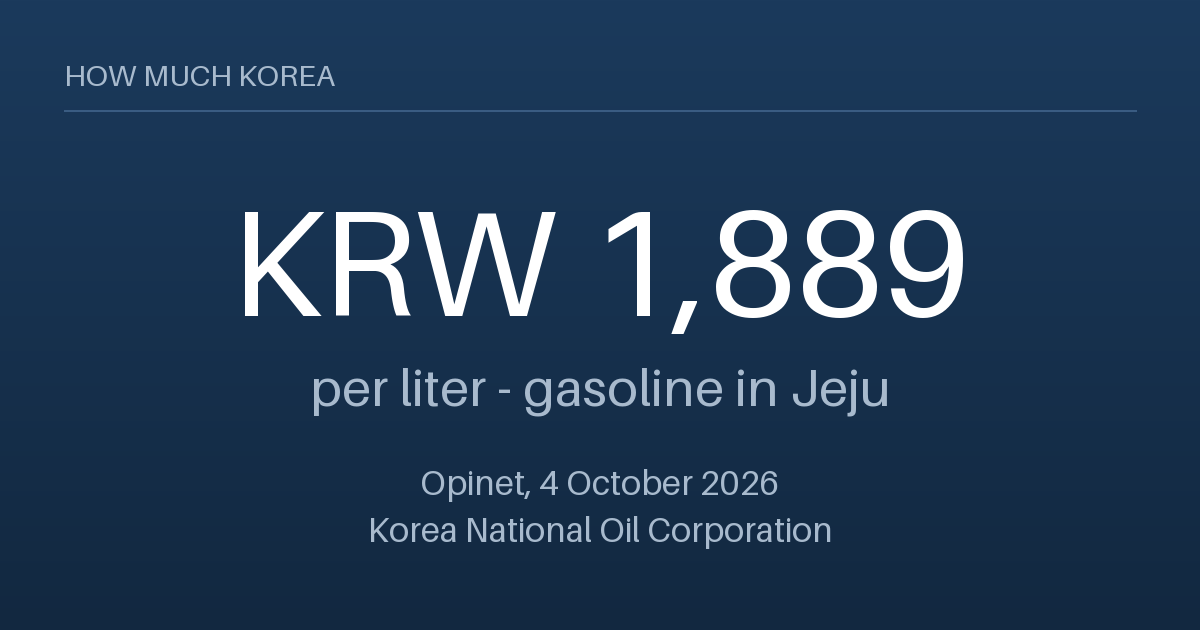
Gasoline in Jeju averages ₩1,889 a liter ($1.39), which works out to $5.26 a US gallon, according to Korea National Oil Corporation (Opinet) figures for 4 October 2026. The national average for the same fuel is ₩1,858, so the island sits a little above it. A full fill-up of regular gasoline comes to ₩75,560 ($55.58) on the assumption we explain further down.
If you searched for Jeju gas prices, fuel prices or the gasoline price today, one point first. This page is a dated snapshot of official averages. It is not a live pump price, and no live source sits behind it.
What are gas prices in Jeju?
Korean pumps sell four common fuels, and the official survey reports an average for each one. In Jeju, regular gasoline is ₩1,889 a liter. Premium gasoline, the higher-octane grade, is ₩2,401 a liter ($1.77). Diesel is ₩1,872 a liter ($1.38). LPG, the liquefied petroleum gas that some Korean cars burn as autogas, is ₩1,181 a liter ($0.87).
Prices are quoted per liter in Korea, so the dollar figures above are per liter too. Readers used to American pumps will find the per-gallon column in the table below more familiar.
| Fuel | Jeju | Per US gallon | National average | Difference |
|---|---|---|---|---|
| Gasoline | ₩1,889 | $5.26 | ₩1,858 | +1.7% |
| Premium gasoline | ₩2,401 | $6.69 | ₩2,335 | +2.8% |
| Diesel | ₩1,872 | $5.21 | ₩1,843 | +1.6% |
| LPG (autogas) | ₩1,181 | $3.29 | ₩1,143 | +3.3% |
The prices are averages of what stations reported to Korea National Oil Corporation (Opinet), rounded to the nearest won. A single station can charge more or less than the average, and the figures say nothing about which stations are cheaper.
How does Jeju compare with the national average?
Fuel on Jeju is more expensive than the national average, and that holds for all four fuels in the table. The gap is not large. Regular gasoline is 1.7% more expensive than the national figure of ₩1,858. Premium is 2.8% more expensive, against a national ₩2,335. Diesel is 1.6% more expensive, against ₩1,843. LPG is 3.3% more expensive, against a national ₩1,143.
In dollar terms, a liter of regular gasoline is $1.39 on Jeju and $1.37 nationally. Premium is $1.77 against $1.72, and diesel is $1.38 against $1.36. LPG is $0.87 against $0.84. These are small differences per liter, and they only matter if you drive a lot.
For the national picture on its own, with the cheapest and priciest provinces, see What are gas prices in Korea, and how much does a fill-up cost?.
How much does a fill-up cost in Jeju?
The fill-up figures on this page are our own assumption, not an official statistic. We multiply each average liter price by a fixed, tank-sized volume, which we chose so the numbers are easy to compare. Your car may take less or more, so scale the figures to its tank.
On that basis, a regular gasoline fill-up costs ₩75,560 ($55.58). Premium costs ₩96,040 ($70.64). Diesel costs ₩74,880 ($55.08). LPG costs ₩47,240 ($34.75).
Per gallon, the figures are $5.26 for regular gasoline, $6.69 for premium, $5.21 for diesel and $3.29 for LPG. If your rental car runs on LPG, a fill-up at ₩47,240 costs less than the ₩75,560 for gasoline. Check the fuel type with the rental company, because this page cannot tell you which fuel a given car uses.
Which Jeju cities have cheaper fuel?
Jeju Province has two cities, Jeju City in the north and Seogwipo in the south, and the survey reports an average for each.
| City | Gasoline | Diesel | LPG |
|---|---|---|---|
| Jeju City | ₩1,894 | ₩1,875 | ₩1,180 |
| Seogwipo | ₩1,879 | ₩1,867 | ₩1,185 |
The official survey cautions that the restaurants it visits change over time, so these figures are not built for comparing one region with another, or one year with the next.
For regular gasoline, Seogwipo is the cheaper of the two, at ₩1,879 against ₩1,894 in Jeju City. Diesel follows the same pattern, with Seogwipo at ₩1,867 and Jeju City at ₩1,875. LPG goes the other way: Jeju City is cheaper, at ₩1,180 against ₩1,185 in Seogwipo.
In dollars, the gasoline gap between the two cities is a matter of $1.38 against $1.39 per liter. That is small enough that a detour to a particular city is unlikely to be worth it. Plan around where you will be driving, not around these averages.
Where does Jeju rank for each fuel type?
The survey also ranks the reporting provinces and cities for each fuel. For regular gasoline, Jeju is 2nd most expensive of 16. For premium gasoline, it is 2nd most expensive of 16. For diesel, it is 2nd most expensive of 16. For LPG, it is 2nd most expensive of 16.
We only describe Jeju’s own place in each ranking here. This page does not compare it with any single other province, and the rank says nothing about how far apart the places are.
Fuel prices in a Jeju trip budget
Fuel is only one line in a trip budget, and on an island it depends on how far you drive. The fill-up figures above give you a unit to work with. Decide how many times you expect to fill the tank, then multiply the fill-up price for your fuel type.
For the other big daily cost, eating, the official dining-out survey has its own page for the island. See What are food prices in Jeju, and how much should you budget? for what a day of restaurant meals costs there. Together, the two pages cover the two costs that official statistics can price. They do not cover rental fees, ferries, flights, parking, tolls or lodging, because we have no sourced figures for those here.
The limits of these figures
Every won figure here is an average reported to Korea National Oil Corporation (Opinet) for 4 October 2026, rounded to the nearest won. A station on the road you take can charge more or less, and prices can differ between neighboring stations. This is not a live price and not a forecast, and it does not say whether prices are rising or falling.
The dollar figures are conversions at a single exchange rate, so they will shift with the currency even when the won price stays put. The gallon figures use the US gallon. The fill-up costs rest on our own tank-size assumption, and your car may differ. The page does not say which fuel your rental car uses or which station sells it cheapest. For that, check the pump when you arrive.
Official figures: average pump prices reported to the Korea National Oil Corporation (Opinet) for 4 October 2026, Jeju and the national average, rounded to the nearest won. A given station can charge more or less. Gallon figures use 1 US gallon = 3.785411784 liters; fill-up costs assume 40 liters. Converted at ₩1,359 = US$1, the Korea Eximbank dealing basis rate for 2 October 2026.