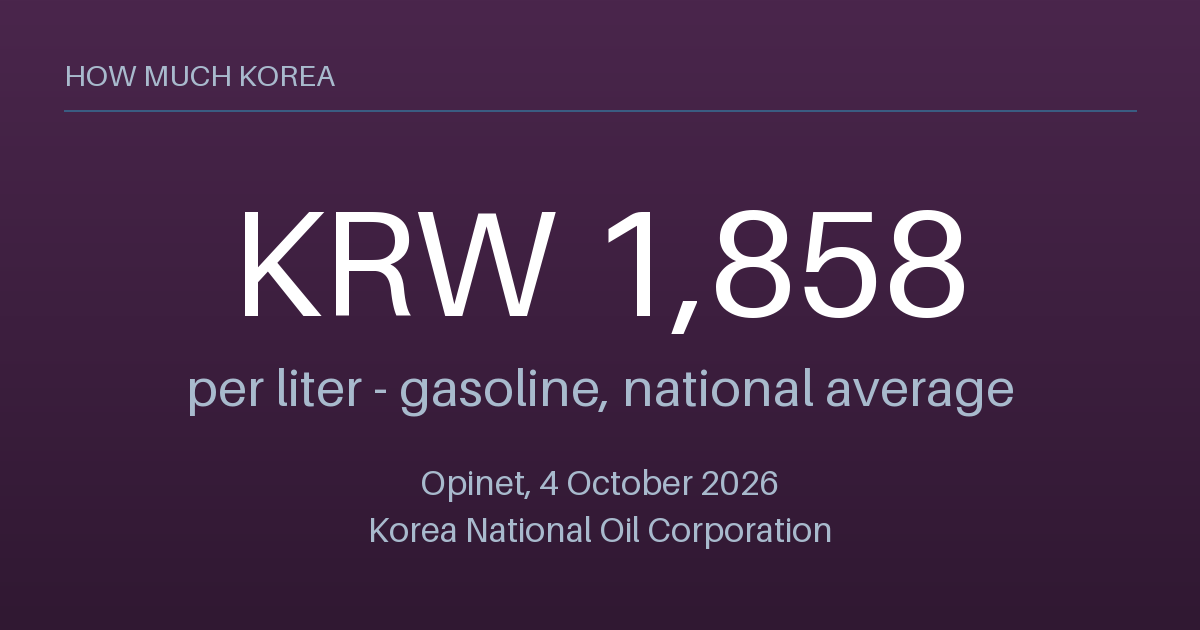
Gas prices in Korea average ₩1,858 per liter for regular gasoline, or $5.17 per US gallon, according to the national average from Korea National Oil Corporation (Opinet) on 4 October 2026. A fill-up of the tank size we assume costs ₩74,320 ($54.66), and the tables below give diesel, premium gasoline and LPG as well.
What are gas prices in Korea?
In Korea the fuel Americans call gas is simply gasoline, and it is sold by the liter. The national average for regular gasoline is ₩1,858 per liter, which is $1.37 at the exchange rate we use. That figure is an official average of pump prices reported to Korea National Oil Corporation (Opinet), the state oil company’s price-reporting service, rather than something we collected from individual stations.
Three other fuels sit beside it at the pump. Premium gasoline averages ₩2,335 per liter. Diesel averages ₩1,843. LPG (liquefied petroleum gas, sold as autogas) averages ₩1,143. The next table puts all four in one place, in won and in dollars.
| Fuel | Per liter | USD per liter | USD per US gallon | 40-liter fill-up |
|---|---|---|---|---|
| Gasoline | ₩1,858 | $1.37 | $5.17 | ₩74,320 |
| Premium gasoline | ₩2,335 | $1.72 | $6.50 | ₩93,400 |
| Diesel | ₩1,843 | $1.36 | $5.13 | ₩73,720 |
| LPG (autogas) | ₩1,143 | $0.84 | $3.18 | ₩45,720 |
The snapshot is dated 4 October 2026. We do not show live prices, so treat the table as a reading taken on that day.
How much is gas in Korea per gallon?
Korean pumps work in liters, so the gallon figure is a conversion we did for readers who think in US gallons. Regular gasoline comes to $5.17 per US gallon at the national average. Premium gasoline comes to $6.50 per gallon, diesel to $5.13, and LPG to $3.18.
The conversion has two steps. First the won price per liter becomes dollars at the exchange rate stated in the note under this article. Then the dollar price per liter is scaled up to a US gallon. Because the exchange rate moves, the dollar numbers will drift even when the pump price in won does not, so if you are comparing against a price at home, the won figure is the steadier one.
How much does a full tank cost in Korea?
Tank sizes differ from car to car, so there is no single honest answer. To give you something to plan with, we assume one fixed fill-up size and multiply it by the average price. That multiplication is our arithmetic, not a survey result, and your own car may take more or less.
On that assumption, regular gasoline costs ₩74,320 ($54.66) for a fill-up. Premium gasoline costs ₩93,400 ($68.70). Diesel costs ₩73,720 ($54.22), and LPG costs ₩45,720 ($33.63).
If you are renting a car, check what fuel it takes before you reach the pump. We do not know which fuel any particular rental runs on, so we do not assume one. If your rental takes regular gasoline, the number to budget around is ₩74,320. If it runs on LPG, the same fill-up costs ₩45,720.
Gasoline, premium, diesel and LPG side by side
Looking at the national averages together, diesel at ₩1,843 per liter is cheaper than regular gasoline at ₩1,858. Premium gasoline at ₩2,335 is more expensive than regular gasoline at ₩1,858. LPG at ₩1,143 is cheaper than diesel at ₩1,843.
Per liter is the number printed on the pump sign, and it is the number we compare here. It is not the whole cost of driving, and we have no source for how far each fuel takes a car. Use the fuel your car requires, and read the table above as a guide to what that fuel costs at the pump.
Which regions have the cheapest and most expensive gas?
The national average of ₩1,858 sits between the lowest and highest areas. For regular gasoline, Daegu has the lowest average at ₩1,829 per liter ($1.35), and Seoul has the highest at ₩1,903 ($1.40). The gap between the two is 4.0%.
For diesel, Daegu is the cheapest area at ₩1,815 per liter and Seoul is the most expensive at ₩1,886, a gap of 3.9%. For premium gasoline the cheapest area is Ulsan at ₩2,294, while Seoul is the most expensive at ₩2,416, a gap of 5.3%.
For LPG, Jeonbuk is the cheapest at ₩1,107 per liter and Seoul is the most expensive at ₩1,203. The gap between those two areas is 8.7%.
Seoul’s regular gasoline at ₩1,903 is 2.4% more expensive than the national average of ₩1,858. Jeju, the island, charges ₩1,889, which is 1.7% more expensive than that national average. Busan charges ₩1,840, and Daegu ₩1,829, which is 1.6% cheaper than the national average.
Regional figures, not a single pump price
The 16 areas in this table are the provinces and major cities that Korea National Oil Corporation (Opinet) reports, ordered here from the lowest regular gasoline average to the highest. Gwangju and Jeonnam are reported together as one area. Each number is an average for the whole area, so it describes the typical pump there and says nothing about any one station.
| Region | Gasoline | Diesel | LPG | Gasoline per US gallon |
|---|---|---|---|---|
| Daegu | ₩1,829 | ₩1,815 | ₩1,162 | $5.09 |
| Ulsan | ₩1,835 | ₩1,826 | ₩1,152 | $5.11 |
| Daejeon | ₩1,837 | ₩1,824 | ₩1,116 | $5.11 |
| Busan | ₩1,840 | ₩1,824 | ₩1,132 | $5.12 |
| Incheon | ₩1,846 | ₩1,829 | ₩1,141 | $5.14 |
| Gyeongbuk | ₩1,852 | ₩1,838 | ₩1,130 | $5.16 |
| Gyeongnam | ₩1,853 | ₩1,837 | ₩1,122 | $5.16 |
| Gyeonggi | ₩1,854 | ₩1,838 | ₩1,145 | $5.16 |
| Sejong | ₩1,855 | ₩1,841 | ₩1,148 | $5.16 |
| Jeonbuk | ₩1,858 | ₩1,846 | ₩1,107 | $5.17 |
| Gwangju-Jeonnam | ₩1,861 | ₩1,851 | ₩1,153 | $5.18 |
| Chungnam | ₩1,864 | ₩1,849 | ₩1,147 | $5.19 |
| Chungbuk | ₩1,865 | ₩1,851 | ₩1,130 | $5.19 |
| Gangwon | ₩1,869 | ₩1,859 | ₩1,173 | $5.20 |
| Jeju | ₩1,889 | ₩1,872 | ₩1,181 | $5.26 |
| Seoul | ₩1,903 | ₩1,886 | ₩1,203 | $5.30 |
The official survey cautions that the restaurants it visits change over time, so these figures are not built for comparing one region with another, or one year with the next.
Use the table to see where your route might matter. Seoul has the highest regular gasoline average, ₩1,903 per liter, so a fill-up there is priced from that figure, while Daegu sits at ₩1,829. That is a gap of 4.0% for gasoline. For the fuel type, premium gasoline averages ₩2,335 against ₩1,858 for regular, and LPG averages ₩1,143.
If you are driving around Jeju, our food budget for the island, What are food prices in Jeju, and how much should you budget?, covers the other half of a road-trip budget. For the meals side across every surveyed area, see What are food prices in Korea, region by region?. And if your trip starts in the capital, How much should you budget for food in Seoul? prices a day of restaurant meals there.
The limits of these figures
These are averages of what stations report, rounded to the nearest won, for the single day of 4 October 2026. Any one station may price above or below the average for its area. We name no specific station and make no claim about where you will find the lowest price.
The gallon and fill-up numbers are our conversions. The gallon figures use a fixed definition of the US gallon and a single exchange rate, and the fill-up figures rest on a tank size we chose. Neither comes from a survey of drivers.
Finally, the page does not say which way prices are heading, and it does not cover electric charging, lubricants or highway tolls. It answers one question: what the average pump price was on the day we checked, nationally and by area.
Official figures: average pump prices reported to the Korea National Oil Corporation (Opinet) for 4 October 2026, national and provincial averages, rounded to the nearest won. A given station can charge more or less. Gallon figures use 1 US gallon = 3.785411784 liters; fill-up costs assume 40 liters. Converted at ₩1,359 = US$1, the Korea Eximbank dealing basis rate for 2 October 2026.