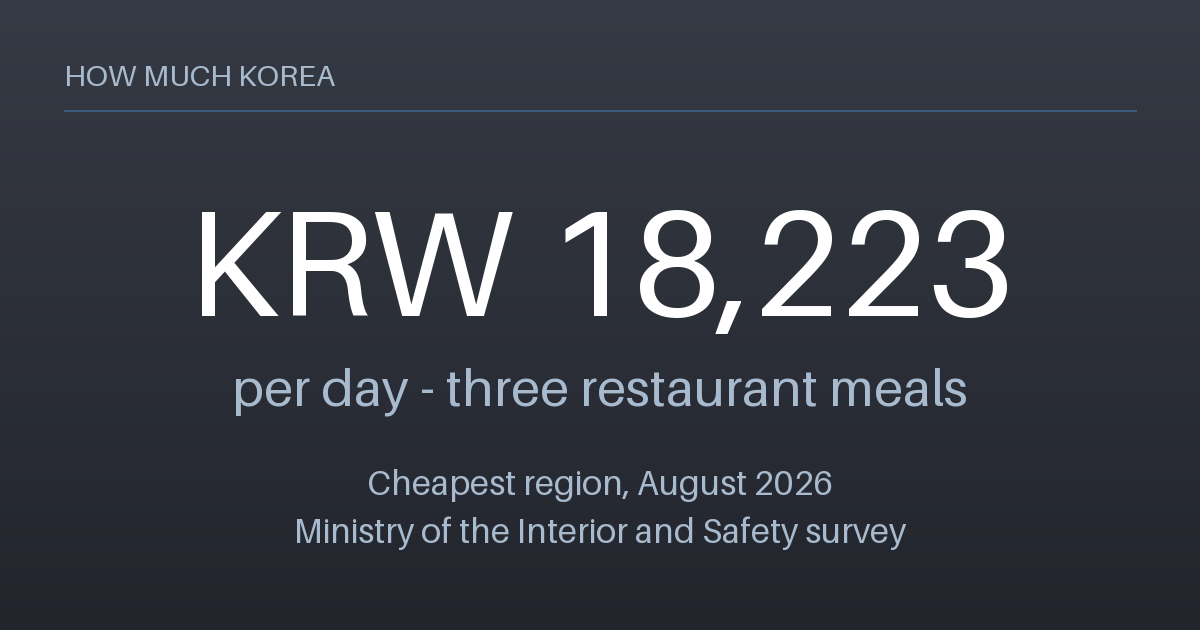
Food prices in Korea depend on the region and the dish: a single restaurant meal in the official survey runs from ₩2,889 ($2.12) to ₩18,269 ($13.44), and three meals in one day add up to between ₩18,223 ($13.40) and ₩34,115 ($25.09). These are official figures for 16 regions, not one national price, and the full table of every region and dish is further down this page.
How much does a meal cost in Korea?
The low end of the survey is Gimbap in Jeonnam, at ₩2,889 ($2.12) for one roll of gimbap (also spelled kimbap, the seaweed-and-rice roll). Jeonnam is South Jeolla province, in the southwest. The high end is Samgyetang in Seoul, at ₩18,269 ($13.44). Samgyetang is ginseng chicken soup, a whole small chicken served in broth, and Seoul is the capital.
Pork belly is not part of that low-to-high span. The survey prices it as meat for sharing, ₩15,305 to ₩21,321 for two hundred grams, and not as a finished single meal.
The everyday dishes sit between the two ends. Bibimbap (rice with mixed vegetables) runs from ₩9,154 to ₩12,100. Kalguksu (knife-cut noodle soup) runs from ₩7,583 to ₩10,375. Jajangmyeon (black-bean noodles) runs from ₩6,846 to ₩7,750. Naengmyeon (cold noodles) runs from ₩9,667 to ₩12,692.
Each figure is an average over the restaurants the survey visited in that region, so your own bill will land somewhat above or below it.
How much does one day of meals cost across regions?
Single dishes do not tell you what to budget, so we built two simple days out of them. The lean version is a gimbap roll, a bowl of jajangmyeon and a kimchi jjigae set. Kimchi jjigae (kimchi stew) in this survey comes as a set with rice and side dishes, not as a bare bowl of stew. The richer version trades the noodles and the stew for bibimbap and samgyetang. These combinations are our own arithmetic on the survey prices, not a surveyed cost of living.
| Region | A budget day | A fuller day | Budget day in USD |
|---|---|---|---|
| Jeonnam | ₩18,223 | ₩29,001 | $13.40 |
| Busan | ₩18,972 | ₩30,658 | $13.95 |
| Daegu | ₩19,000 | ₩30,884 | $13.97 |
| Gyeongbuk | ₩19,231 | ₩29,447 | $14.14 |
| Incheon | ₩19,417 | ₩29,834 | $14.28 |
| Ulsan | ₩19,500 | ₩30,500 | $14.34 |
| Gyeongnam | ₩19,539 | ₩30,116 | $14.37 |
| Gangwon | ₩19,556 | ₩30,389 | $14.38 |
| Chungnam | ₩19,780 | ₩29,530 | $14.55 |
| Chungbuk | ₩20,000 | ₩28,429 | $14.71 |
| Jeonbuk | ₩20,150 | ₩33,100 | $14.82 |
| Gyeonggi | ₩20,186 | ₩31,394 | $14.85 |
| Gwangju | ₩20,360 | ₩31,460 | $14.97 |
| Seoul | ₩20,423 | ₩34,115 | $15.02 |
| Jeju | ₩21,000 | ₩31,125 | $15.45 |
| Daejeon | ₩21,500 | ₩30,800 | $15.81 |
The official survey cautions that the restaurants it visits change over time, so these figures are not built for comparing one region with another, or one year with the next.
Across all regions the lean version starts at ₩18,223 in Jeonnam, and the richer version reaches ₩34,115 in Seoul. In dollars that span is $13.40 to $25.09. Find the province you plan to visit in the table and read its row for both versions.
Regional figures, not a national average
There is no single price for food in Korea, and this page does not invent one. Each number belongs to one region: it is the average of the restaurants checked there. No country-wide figure is published on the same basis, and blending the regional ones would hide what matters most to a traveler, which is how far the answer moves from place to place.
That is why the opening answer is a range and not a midpoint. The ends come from named regions and named dishes, and the tables show which. For a closer look at one city, the pages linked near the end of this article cover a single place each.
The survey lists Gwangju (a metropolitan city in the southwest) and Jeonnam under one combined heading. The figures here are each area’s own, so Gwangju and Jeonnam appear as separate rows.
How much does each dish vary from region to region?
Some region names are short forms, so here is a key before the figures. Chungbuk and Chungnam are North and South Chungcheong, in the center of the country. Gyeongbuk and Gyeongnam are North and South Gyeongsang, in the southeast. Jeonbuk and Jeonnam are North and South Jeolla, in the southwest. Daegu and Daejeon are metropolitan cities, in the southeast and the center. Jeju is the island province off the south coast.
The next table gives the lowest and highest regional price for every dish, with the percentage gap between them and the regions at both ends.
| Dish | Unit | Lowest | Highest | Difference |
|---|---|---|---|---|
| Samgyeopsal (grilled pork belly) | 200g | ₩15,305 (Chungbuk) | ₩21,321 (Seoul) | +39.3% |
| Samgyetang (ginseng chicken soup) | 1 serving | ₩15,714 (Chungbuk) | ₩18,269 (Seoul) | +16.3% |
| Naengmyeon (cold noodles) | 1 serving | ₩9,667 (Jeonnam) | ₩12,692 (Seoul) | +31.3% |
| Bibimbap | 1 serving | ₩9,154 (Gyeongnam) | ₩12,100 (Jeonbuk) | +32.2% |
| Kalguksu (knife-cut noodles) | 1 serving | ₩7,583 (Daegu) | ₩10,375 (Jeju) | +36.8% |
| Kimchi jjigae set meal | 1 serving | ₩8,278 (Jeonnam) | ₩10,600 (Daejeon) | +28.1% |
| Jajangmyeon (black-bean noodles) | 1 serving | ₩6,846 (Gyeongbuk) | ₩7,750 (Jeju) | +13.2% |
| Gimbap | 1 roll | ₩2,889 (Jeonnam) | ₩3,923 (Seoul) | +35.8% |
The official survey cautions that the restaurants it visits change over time, so these figures are not built for comparing one region with another, or one year with the next.
In words, pork belly for two hundred grams runs from ₩15,305 in Chungbuk to ₩21,321 in Seoul, a gap of 39.3%. Samgyetang runs from ₩15,714 in Chungbuk to ₩18,269 in Seoul, a gap of 16.3%. Naengmyeon runs from ₩9,667 in Jeonnam to ₩12,692 in Seoul, a gap of 31.3%.
Bibimbap goes from ₩9,154 in Gyeongnam to ₩12,100 in Jeonbuk, a gap of 32.2%. Kalguksu goes from ₩7,583 in Daegu to ₩10,375 in Jeju, a gap of 36.8%. The kimchi jjigae set goes from ₩8,278 in Jeonnam to ₩10,600 in Daejeon, a gap of 28.1%.
Jajangmyeon goes from ₩6,846 in Gyeongbuk to ₩7,750 in Jeju, a gap of 13.2%. Gimbap goes from ₩2,889 in Jeonnam to ₩3,923 in Seoul, a gap of 35.8%.
Which regions sit at the two ends of the daily totals?
The lean total bottoms out at ₩18,223, in Jeonnam. The richer total peaks at ₩34,115, in Seoul. Seoul’s own two totals are ₩20,423 and ₩34,115.
The two versions are built from different dishes, so one province’s row can look different from another’s. Jeonnam’s totals are ₩18,223 and ₩29,001. Daejeon shows ₩21,500 and ₩30,800. Read both columns before judging a place.
The complete price list follows. It covers every region and every dish in the survey, in won, with pork belly per two hundred grams, gimbap per roll and the rest per serving.
| Region | Pork belly 200g | Samgyetang | Naengmyeon | Bibimbap |
|---|---|---|---|---|
| Seoul | 21,321 | 18,269 | 12,692 | 11,923 |
| Busan | 18,175 | 17,429 | 12,000 | 9,686 |
| Daegu | 18,470 | 17,167 | 11,750 | 10,467 |
| Incheon | 17,685 | 17,000 | 11,917 | 9,167 |
| Gwangju | 16,533 | 16,800 | 10,600 | 10,800 |
| Daejeon | 18,600 | 16,800 | 11,000 | 10,700 |
| Ulsan | 17,677 | 15,800 | 10,800 | 11,200 |
| Gyeonggi | 18,197 | 17,690 | 10,931 | 9,945 |
| Gangwon | 15,963 | 16,556 | 10,556 | 10,444 |
| Chungbuk | 15,305 | 15,714 | 9,714 | 9,429 |
| Chungnam | 17,742 | 16,200 | 10,500 | 10,050 |
| Jeonbuk | 16,300 | 17,600 | 10,500 | 12,100 |
| Jeonnam | 18,975 | 16,556 | 9,667 | 9,556 |
| Gyeongbuk | 17,306 | 16,077 | 10,346 | 9,908 |
| Gyeongnam | 19,836 | 17,231 | 10,808 | 9,154 |
| Jeju | 17,944 | 17,000 | 9,750 | 10,500 |
| Region | Kalguksu | Kimchi jjigae set | Jajangmyeon | Gimbap |
|---|---|---|---|---|
| Seoul | 10,038 | 8,769 | 7,731 | 3,923 |
| Busan | 8,071 | 8,429 | 7,000 | 3,543 |
| Daegu | 7,583 | 8,583 | 7,167 | 3,250 |
| Incheon | 8,833 | 8,667 | 7,083 | 3,667 |
| Gwangju | 9,400 | 9,100 | 7,400 | 3,860 |
| Daejeon | 8,800 | 10,600 | 7,600 | 3,300 |
| Ulsan | 9,500 | 9,000 | 7,000 | 3,500 |
| Gyeonggi | 9,810 | 8,841 | 7,586 | 3,759 |
| Gangwon | 9,389 | 9,000 | 7,167 | 3,389 |
| Chungbuk | 8,857 | 9,714 | 7,000 | 3,286 |
| Chungnam | 9,200 | 9,400 | 7,100 | 3,280 |
| Jeonbuk | 9,300 | 9,550 | 7,200 | 3,400 |
| Jeonnam | 9,222 | 8,278 | 7,056 | 2,889 |
| Gyeongbuk | 8,462 | 8,923 | 6,846 | 3,462 |
| Gyeongnam | 8,077 | 8,808 | 7,000 | 3,731 |
| Jeju | 10,375 | 9,625 | 7,750 | 3,625 |
The official survey cautions that the restaurants it visits change over time, so these figures are not built for comparing one region with another, or one year with the next.
More pages on Korean food prices
Three pages on this site stay in one place and go deeper. For the capital, see How much should you budget for food in Seoul?. For the second city, see How much should you budget for food in Busan?. For the island, see How much should you budget for food in Jeju?. Each lists its own dishes and daily totals.
If grilled meat is what you are planning dinner around, the survey figure for pork belly is only part of the story, and How much is Korean BBQ in Seoul? Official average vs menu prices sets the official price beside what real menus charge. Drinks are priced separately in How much is a bottle of soju in Korea? Shop vs restaurant prices.
The limits of these figures
All of these numbers come from one survey, taken in August 2026, and the agency marks them provisional, so they may be revised. They are regional averages. A single restaurant will rarely match one, and a busy tourist district can charge well above its region’s figure.
The restaurants the survey visits also change over time, so setting one region beside another, or one month beside the next, gives you a rough sense of scale and nothing sharper. The daily totals are sums of the dishes named above in our own combinations. They leave out coffee, snacks, delivery, alcohol and street food, because the survey does not price them and this site does not print figures it cannot trace.
Dollar amounts are converted from won at the Korea Eximbank dealing basis rate on a single date, so they drift as the exchange rate moves. Trust the won figures.
Official figures: the Chamgagyeok dining-out survey, August 2026, all regions surveyed. Daily totals are sums of those figures, in the combinations stated in the tables. Converted at ₩1,359 = US$1, the Korea Eximbank dealing basis rate for 2 October 2026.