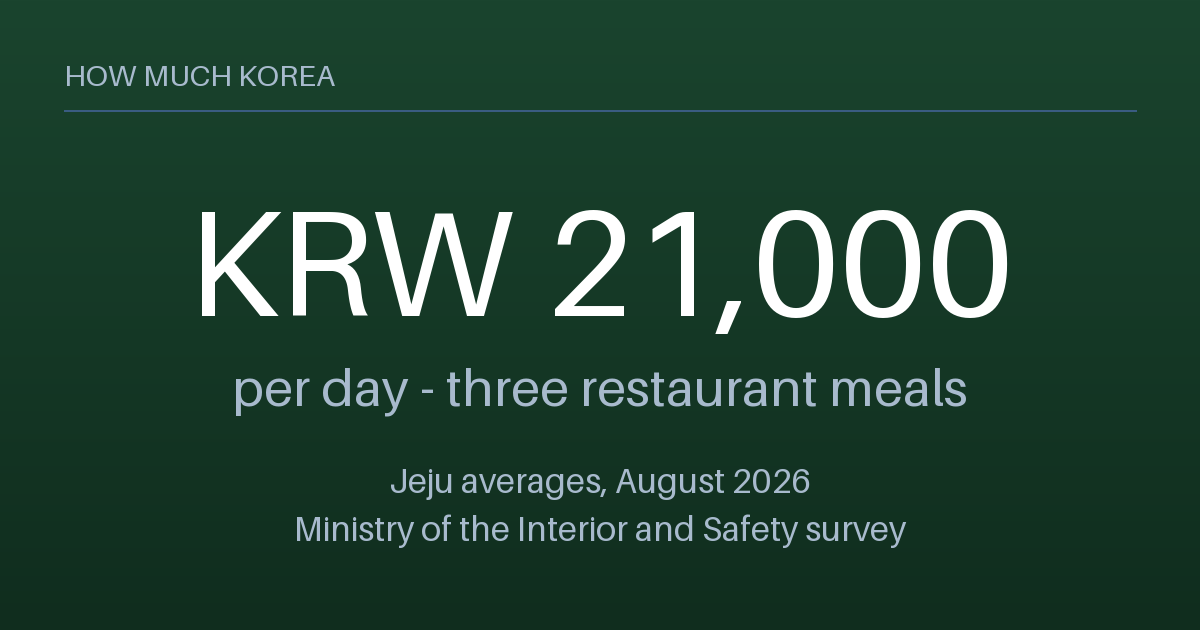
Food prices in Jeju run to ₩21,000 to ₩31,125 ($15.45 to $22.89) for a day of three restaurant meals, at official average prices. The low end pairs a roll of gimbap (rolled rice with vegetables) with a bowl of noodles and a stew set meal. The high end trades in rice with toppings and a chicken soup. Every figure comes from the government’s dining-out survey for August 2026, and each step of the sums is shown so you can change the plan to suit your own appetite.
How much should you budget for food in Jeju per day?
Both plans use only dishes that the survey prices. The lean plan starts with gimbap (also spelled kimbap) in the morning, moves to jajangmyeon (black-bean noodles) at midday and ends with a kimchi jjigae (kimchi stew) set meal in the evening. The fuller plan keeps the gimbap but puts bibimbap (rice topped with vegetables and egg) at midday and samgyetang (ginseng chicken soup) at night.
| A budget day | Price | USD | |
|---|---|---|---|
| Breakfast | Gimbap (1 roll) | ₩3,625 | $2.67 |
| Lunch | Jajangmyeon (black-bean noodles) | ₩7,750 | $5.70 |
| Dinner | Kimchi jjigae set meal | ₩9,625 | $7.08 |
| Total | ₩21,000 | $15.45 |
| A fuller day | Price | USD | |
|---|---|---|---|
| Breakfast | Gimbap (1 roll) | ₩3,625 | $2.67 |
| Lunch | Bibimbap | ₩10,500 | $7.72 |
| Dinner | Samgyetang (ginseng chicken soup) | ₩17,000 | $12.50 |
| Total | ₩31,125 | $22.89 |
The lean day adds up to ₩21,000, which is $15.45. The fuller day adds up to ₩31,125, which is $22.89. We chose these combinations ourselves; they are not a measured spending figure. A sit-down morning meal is also a generous assumption, since plenty of residents grab a quick bite instead or eat nothing until noon. If that is you, delete the first line and subtract it from the total.
What are typical Jeju food prices for common Korean dishes?
Each price in the next table is a Jeju-wide average for a single serving, with one exception. Samgyeopsal (grilled pork belly) is recorded as a weighed amount of raw meat, and the unit column shows that weight. It is not a complete meal with rice, side dishes and drinks, so we keep it out of the daily plans above.
| Dish | Unit | Jeju average | USD |
|---|---|---|---|
| Samgyeopsal (grilled pork belly) | 200g | ₩17,944 | $13.20 |
| Samgyetang (ginseng chicken soup) | 1 serving | ₩17,000 | $12.50 |
| Naengmyeon (cold noodles) | 1 serving | ₩9,750 | $7.17 |
| Bibimbap | 1 serving | ₩10,500 | $7.72 |
| Kalguksu (knife-cut noodles) | 1 serving | ₩10,375 | $7.63 |
| Kimchi jjigae set meal | 1 serving | ₩9,625 | $7.08 |
| Jajangmyeon (black-bean noodles) | 1 serving | ₩7,750 | $5.70 |
| Gimbap | 1 roll | ₩3,625 | $2.67 |
Treat the table as a menu where you can swap lines. A kalguksu (knife-cut noodle soup) lunch at ₩10,375 in place of jajangmyeon at ₩7,750 raises the day by the gap between them. Naengmyeon (cold noodles) at ₩9,750 falls between those two bowls. Pick the lines you like and add them up.
Which dishes are cheapest and priciest in Jeju?
Setting pork belly aside, the lowest Jeju average in the survey belongs to Gimbap, at ₩3,625 ($2.67) for one roll. The highest belongs to Samgyetang (ginseng chicken soup), at ₩17,000 ($12.50). Pork belly is quoted for a weighed portion of meat, not a serving, at ₩17,944 ($13.20), so it is left out of that ranking.
The dishes in between sit close together. Bibimbap is ₩10,500, kalguksu is ₩10,375, naengmyeon is ₩9,750 and the kimchi jjigae set meal is ₩9,625. On that last item, note that the survey prices a set meal that includes rice and side dishes, so it is more than a bowl of stew by itself.
Is food in Jeju cheaper than in Seoul?
Mixed. Comparing the two sets of averages, the verdict is mixed: Jeju is cheaper on 5 of the 8 dishes that the survey prices in both places, and dearer on 3 of the 8.
The daily totals tell the same story. The lean plan costs ₩21,000 in Jeju and ₩20,423 in Seoul, so Jeju is a little dearer. The fuller plan costs ₩31,125 in Jeju and ₩34,115 in Seoul, so Jeju is cheaper there. Which side your own trip lands on depends on what you order. For the full Seoul version of this budget, see How much should you budget for food in Seoul?.
Which dishes cost more in Jeju than in Seoul, and which cost less?
| Dish | Jeju | Seoul | Difference |
|---|---|---|---|
| Samgyeopsal (grilled pork belly) | ₩17,944 | ₩21,321 | -15.8% |
| Samgyetang (ginseng chicken soup) | ₩17,000 | ₩18,269 | -6.9% |
| Naengmyeon (cold noodles) | ₩9,750 | ₩12,692 | -23.2% |
| Bibimbap | ₩10,500 | ₩11,923 | -11.9% |
| Kalguksu (knife-cut noodles) | ₩10,375 | ₩10,038 | +3.4% |
| Kimchi jjigae set meal | ₩9,625 | ₩8,769 | +9.8% |
| Jajangmyeon (black-bean noodles) | ₩7,750 | ₩7,731 | +0.2% |
| Gimbap | ₩3,625 | ₩3,923 | -7.6% |
The official survey cautions that the restaurants it visits change over time, so these figures are not built for comparing one region with another, or one year with the next.
For the largest gap in Jeju’s favor, the survey data gives Naengmyeon (cold noodles) (23.2% cheaper) against Seoul. The largest gap the other way is Kimchi jjigae set meal (9.8% more expensive). Pork belly is 15.8% cheaper in Jeju, at ₩17,944 against ₩21,321 for the same weighed portion. Samgyetang is 6.9% cheaper, bibimbap is 11.9% cheaper and gimbap is 7.6% cheaper.
Kalguksu is 3.4% more expensive, and jajangmyeon is 0.2% more expensive, a difference small enough to ignore. Read the whole column rather than one row, because the set meal is dearer in Jeju while the cold noodles are cheaper, and both are true together.
If grilled pork is the centerpiece of your plans, our page on How much is Korean BBQ in Seoul? Official average vs menu prices looks at that dish in the capital. The Jeju figure above is the official average for this island only.
What this page cannot tell you
These numbers are averages for the island, taken from a monthly survey that marks them provisional. The place where you sit down will differ. A restaurant in a busy tourist area, a seafood counter near the harbor or a late-night spot may charge well above or below the average, and nothing here captures that.
The survey itself warns that the restaurants it visits change over time. For that reason it is not designed to compare one region with another, or one month with the next. We show Seoul beside Jeju because readers ask for it, but take it as a rough guide and not a precise percentage. The daily totals are our own sums of surveyed dishes, not a surveyed cost of living.
Finally, the budget covers only what the survey prices. Cafés and coffee, alcohol, delivery, street food, snacks and desserts are all absent, as are lodging and transport. We do not print a number that we cannot trace to a source, so every total stays within the dishes in the tables.
Official figures: the Chamgagyeok dining-out survey, August 2026, Jeju and Seoul. Daily totals are sums of those figures, in the combinations stated in the tables. Converted at ₩1,359 = US$1, the Korea Eximbank dealing basis rate for 2 October 2026.