Short answer: Korean BBQ in Seoul usually means samgyeopsal — pork belly grilled at your table — and the official average for it is ₩21,321 ($15.40) per 200g. Individual restaurants sit both on and well above that line — the two below differ by more than a third, and they are a few minutes apart.
How much does eating out cost in Seoul?
| Dish | Unit | Seoul average | USD |
|---|---|---|---|
| Samgyeopsal (grilled pork belly) | 200g | ₩21,321 | $15.40 |
| Samgyetang (ginseng chicken soup) | 1 serving | ₩18,154 | $13.11 |
| Naengmyeon (cold noodles) | 1 serving | ₩12,615 | $9.11 |
| Bibimbap | 1 serving | ₩11,769 | $8.50 |
| Kalguksu (knife-cut noodles) | 1 serving | ₩10,038 | $7.25 |
| Kimchi jjigae set meal | 1 serving | ₩8,654 | $6.25 |
| Jajangmyeon (black-bean noodles) | 1 serving | ₩7,654 | $5.53 |
| Gimbap | 1 roll | ₩3,838 | $2.77 |
If some of those are unfamiliar: samgyeopsal is pork belly grilled at the table, usually ordered for two or more and eaten wrapped in lettuce. Samgyetang is a whole young chicken stuffed with rice and ginseng in a clear broth — the most expensive thing on the list and a summer dish rather than a winter one. Naengmyeon is cold buckwheat noodles, often ordered at the end of a grilled-meat meal. Bibimbap is rice with vegetables and chilli paste, mixed at the table. Kalguksu is a bowl of hand-cut wheat noodles in broth, and jajangmyeon is wheat noodles in black bean sauce, which is Korean-Chinese rather than Korean and priced accordingly.
The two cheapest entries are the ones worth knowing about. A kimchi jjigae set meal is a working lunch: the stew, rice, and a spread of side dishes, for less than the price of a coffee and a pastry in most Western capitals. Gimbap is a seaweed rice roll sold everywhere, cut into rounds, and it is the cheapest way to eat a real meal in Korea. Neither is tourist food, which is rather the point — they are what the price survey found in ordinary restaurants.
Why does the weight on the menu matter?
The official figure is normalised to 200g, but restaurants sell by the 인분 (portion), and a portion is not a fixed size — the survey itself records portions anywhere from 100g to 250g before converting them. This is less of a problem than it sounds, because of a rule most visitors never hear about: since January 2013, restaurants in Korea have been required to show the price of meat per 100g. Where a place sells by the portion it may print the portion weight alongside that per-100g figure, which is why a meat menu here usually carries two numbers next to the dish rather than one.
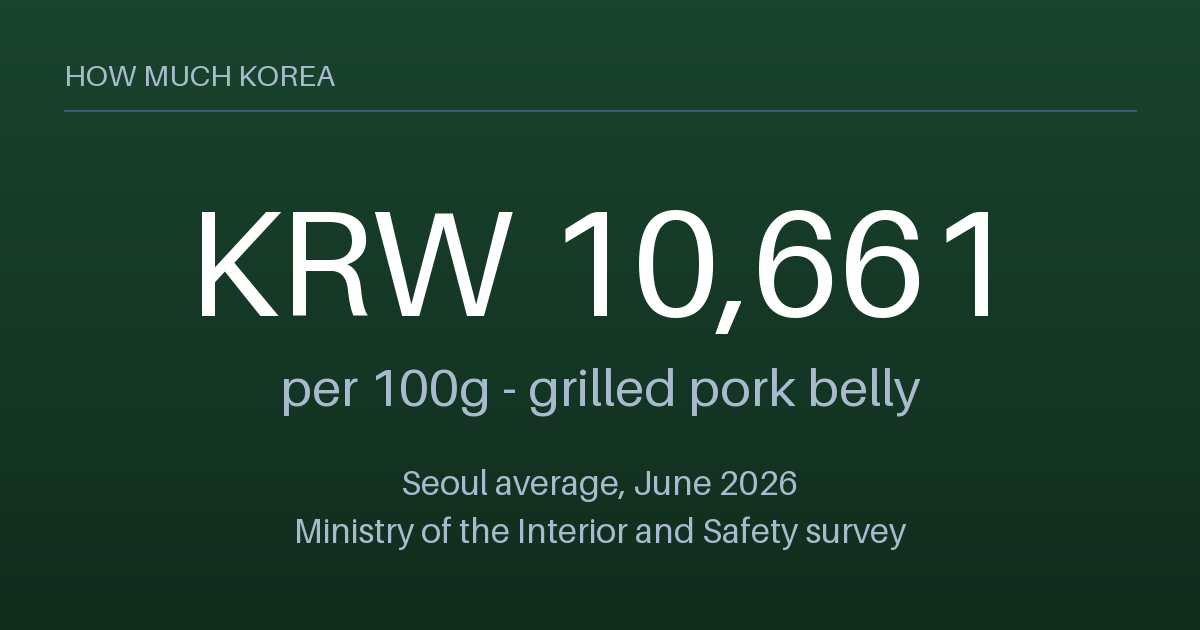
So you have a per-100g number on almost every meat menu, and a per-100g number for the city as a whole. Compare those two and the portion sizes stop mattering. A menu with no weight and no per-100g price is missing information you are entitled to.
When is a Korean BBQ price too high?
| Price per 100g | What it means |
|---|---|
| Below ₩10,661 | Below the city average. Common in ordinary neighbourhood places. |
| ₩10,661 to ₩15,992 | The ordinary range. A tourist district sits at the top of it. |
| Above ₩15,992 | Expensive — fair only if the menu says why. |
Half again above the average is a deliberately generous line. Rent in central Seoul is genuinely higher, staff cook the meat for you in many places, and the average includes cheap suburbs that no visitor will ever eat in. A restaurant can be well inside that band and still be a perfectly normal business.
When is a higher price the pork, not a markup?
There is a real exception, and it is common enough that you should know it before deciding you have been overcharged. Pork in Korea is not one product. A menu may name a breed — Jeju black pork, Iberico, one of several domestic heritage pigs — or an ageing process, usually written as 숙성, dry-aged for a stated number of days. Both of those cost the restaurant more, and both are priced higher on every menu that carries them.
Both restaurants below are selling aged pork, which is why neither is a clean comparison with the plain city average. The practical test is inside the menu rather than outside it: a place that sells aged or specialty pork almost always lists a plain 생삼겹살 as well. If the ordinary cut is priced normally and the specialty one is not, you are looking at a product decision. If there is no ordinary cut on the menu at all and every price is high, you are looking at something else.
Three other things move the price without being a rip-off. Ogyeopsal is the same belly with the skin left on and is a different cut, not a markup. Frozen pork is cheaper than fresh and is usually labelled as such, so a very low price is not always the bargain it looks like. All-you-can-eat places price by time rather than by weight, which puts them outside this comparison entirely.
What do two Myeongdong restaurants actually charge?
| Restaurant | As printed on the menu | Menu price | Per 100g | vs Seoul average |
|---|---|---|---|---|
| Yuktongnyeong (육통령) | 오미자숙성광개토삼겹살(150g) Omija-aged pork belly, Gwanggaeto brand – 150g | ₩16,000 | ₩10,667 | +0.1% |
| Dukkeopsam Myeongdong (두껍삼 명동직영점) | 숙성삼겹살 /150g Aged pork belly – 150g | ₩21,000 | ₩14,000 | +31.3% |
Both are in Myeongdong, the district every guidebook flags as a tourist trap. Yuktongnyeong lands on the city average almost exactly (+0.1%); Dukkeopsam Myeongdong sits at +31.3%. The gap here is between restaurants, not between neighbourhoods — which is why “avoid Myeongdong” is weaker advice than “read the weight on the menu”.
How do you check a price before you sit down?
One more thing that makes the arithmetic look worse than it is. The side dishes arrive without being ordered and are refilled without being charged for — lettuce, garlic, sauces, kimchi, usually a salad. That is standard, and being charged for a lettuce refill is not. Rice, stews and the cold noodles at the end are ordered separately and do cost extra, so a meal comes to more than the meat price, but the table full of small dishes is part of what you have already paid for.
You can check any of this before you sit down. Korean restaurants post their menus, and customers photograph them — the prices in the table below were read off exactly those photographs rather than from a listing. Look for the per-100g line, compare it with the figure above, and if a menu shows only 1인분 with no weight and no per-100g price, that is worth asking about before ordering rather than after.
What this page cannot tell you
What this page is not: the official figures are a city-wide average, and the survey itself cautions that the restaurants it visits change over time, so it is not built for comparing one province with another or one year with the next. The two restaurants are examples with their menus attached, not a sample of anything — a search ranking chose them, not a statistician. Both numbers are menu prices rather than the cost of a meal. Used together they answer a narrow question well: is the price in front of me an ordinary Korean price, or not?
It is also a page about pork. Samgyeopsal is the ordinary Korean BBQ order and the one the official survey prices, but a beef galbi restaurant is a different bracket altogether and nothing here applies to it. If the menu in front of you is beef, this page will tell you the wrong thing.
Official figures: the Chamgagyeok dining-out survey, June 2026, Seoul. Restaurant prices read from the menus displayed in each restaurant and still listed at these prices on 23 August 2026. Converted at ₩1,384 = US$1, the Korea Eximbank dealing basis rate for 27 August 2026.
Bottom line. The number to carry around is ₩10,661 per 100g — the Seoul average for grilled pork belly, in the same unit the menu is legally required to show. Anything close to it is an ordinary price, whichever district you are standing in.