
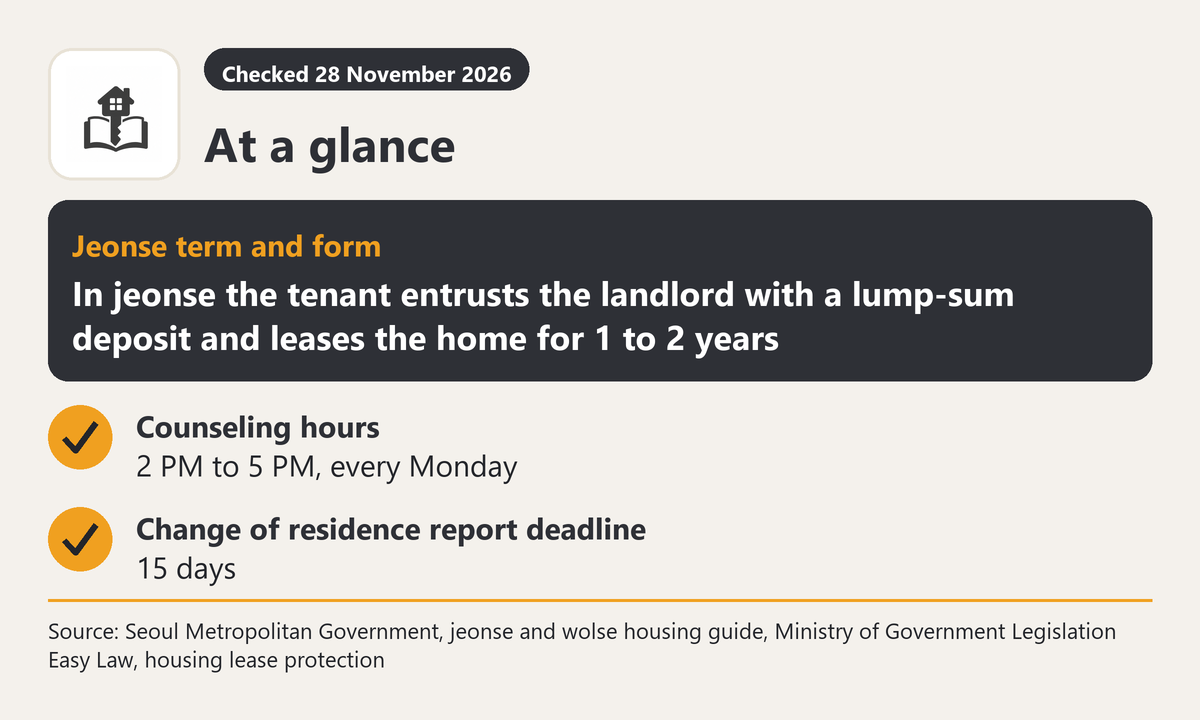
In jeonse the tenant entrusts the landlord with a lump-sum deposit and leases the home for 1 to 2 years. In wolse the tenant pays a small deposit on a 1 to 2 year contract and pays monthly rent. A foreign national who has completed alien registration and reported their change of residence may be exceptionally protected under the Housing Lease Protection Act.
| What | Detail |
|---|---|
| Jeonse term and form | In jeonse the tenant entrusts the landlord with a lump-sum deposit and leases the home for 1 to 2 years |
| Jeonse deposit at the end | After the contract ends, the landlord must fully return the jeonse amount |
| Wolse term and form | In wolse the tenant pays a small deposit on a 1 to 2 year contract and pays monthly rent |
| Typical wolse deposit size | The wolse deposit is generally ten to twenty times the monthly rent |
| Counseling hours | 2 PM to 5 PM, every Monday |
| Foreigner protection | A foreign national who has completed alien registration and reported their change of residence may be exceptionally protected under the Housing Lease Protection Act |
| Change of residence report deadline | 15 days |
What is the difference between jeonse and wolse?
The wolse deposit is generally ten to twenty times the monthly rent. Ten percent of the jeonse is paid as deposit and the rest is paid upon moving in. Generally, ten percent of the deposit is paid as the contract fee and the remainder is paid upon moving in.
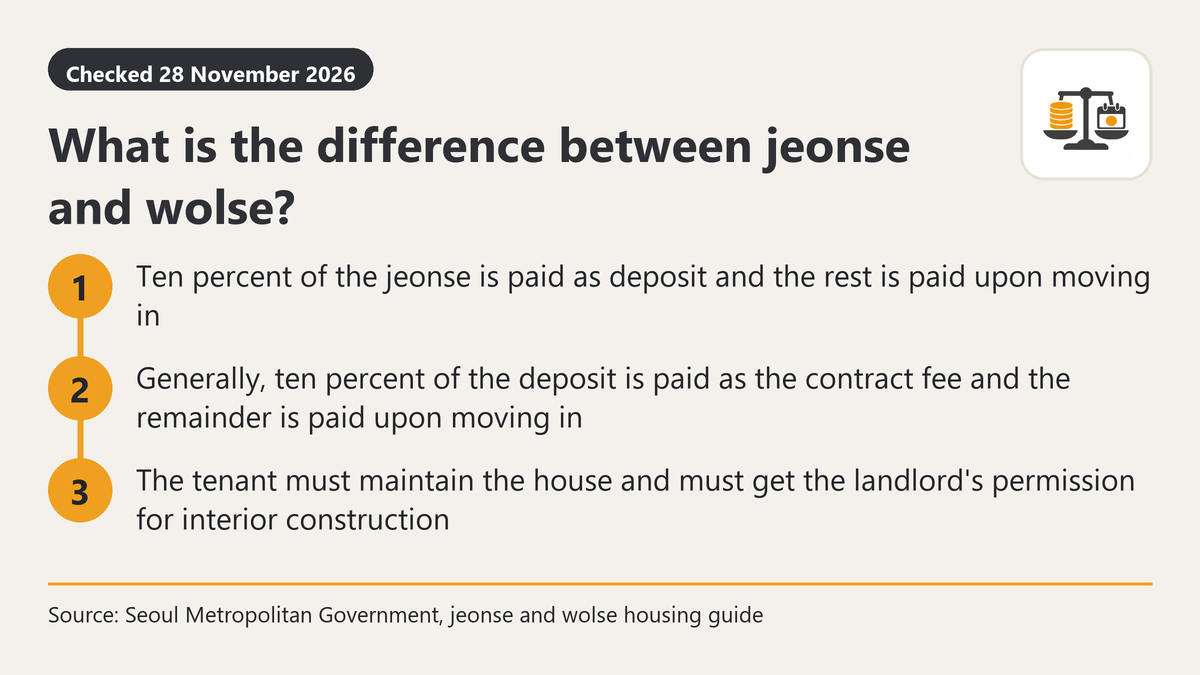
The tenant must maintain the house and must get the landlord’s permission for interior construction.
What alien registration and a residence report change for foreign tenants
In principle, foreign nationals are not covered by the Housing Lease Protection Act.
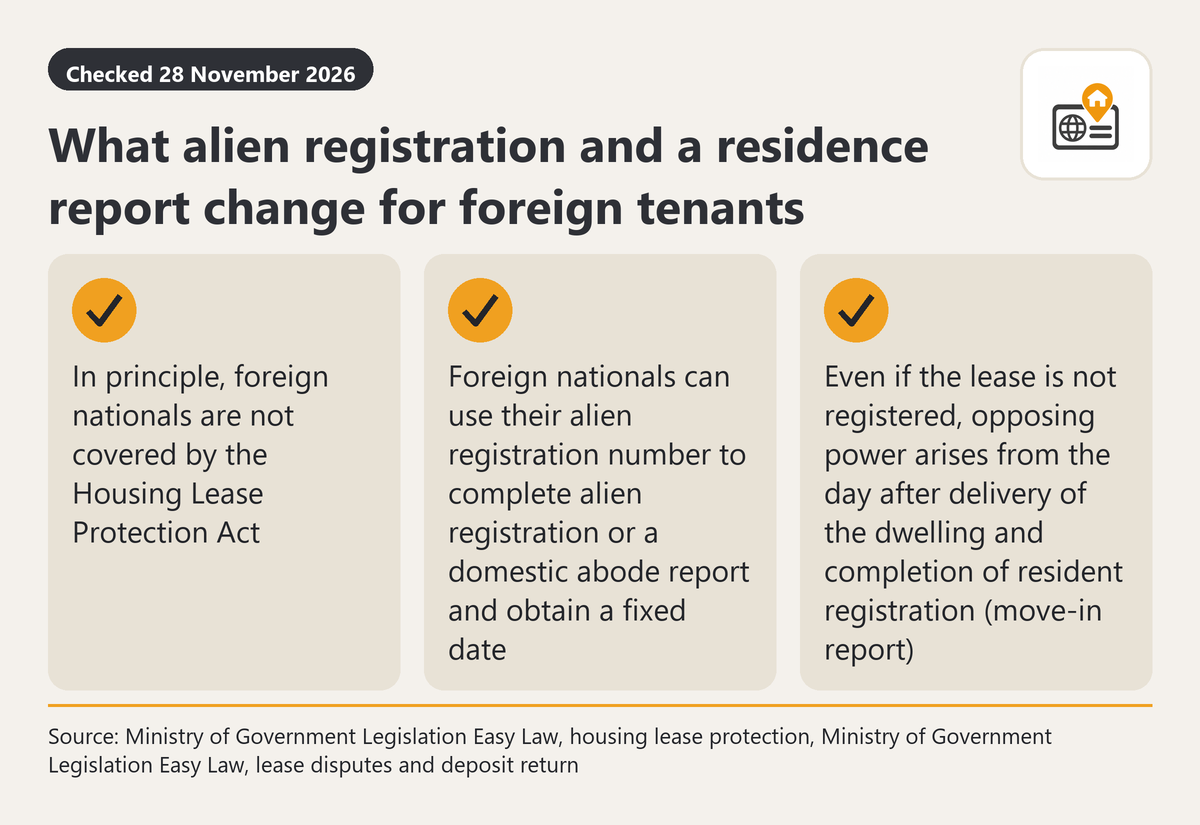
Foreign nationals can use their alien registration number to complete alien registration or a domestic abode report and obtain a fixed date. Even if the lease is not registered, opposing power arises from the day after delivery of the dwelling and completion of resident registration (move-in report).
For opening a bank account, see How to open a bank account in Korea as a foreigner: who can, what to bring and what to expect. For health insurance enrollment, see Do foreigners living in Korea have to join the national health insurance?.
The deposit that comes back at the end of a jeonse
After the contract ends, the landlord must fully return the jeonse amount.
Wolse as a smaller deposit with monthly rent on top
If the tenant ends the wolse contract midway, they are not eligible for a deposit refund; if the landlord ends it midway, they must compensate the tenant with double the deposit.
If there are arrears in rent or utilities, the deposit can be returned excluding these arrears. Brokerage fees can differ according to the type, size, and price of the home.
Steps that protect your deposit before and after you move in
Seoul offers in-depth real estate transaction consulting to help prevent jeonse scams and housing lease disputes.
| What | Detail |
|---|---|
| Counseling location | Seoul Foreign Resident Center, 40 Dosin-ro, Yeongdeungpo-gu, Seoul |
| Counseling hours | 2 PM to 5 PM, every Monday |
| Counseling languages | English, Chinese, Vietnamese, Mongolian, Russian, Uzbek, and Urdu |
File the change of residence report within 15 days of signing and taking possession of the home.
- Verify the property’s condition and the legal rights of the owner, mortgage holders, and existing tenants through the certified copy of the real estate register.
- Check the building register to determine whether the property is unauthorized or illegally constructed.
- Verify whether the lessor has any overdue national or local taxes by checking their tax payment certificates.
- Confirm that the realtor is properly licensed through the realtor registration certificate.
- Any verbal agreements with the lessor should be documented in the special terms section of the lease agreement.
- On signing day, before the final payment, re-check the certified copy of the register for changes in ownership or rights and confirm the previous tenant has vacated.
- After securing perfection, obtain a fixed date on the lease agreement to acquire the right to preferential repayment over subordinate creditors in an auction or public sale.
Where to take a dispute with a landlord
A tenant may claim default interest of 5% a year when the landlord delays the return without just cause.
| What | Detail |
|---|---|
| Content-certified mail | Send content-certified mail stating the lease, the deposit amount to be returned, and so on |
| Payment order | Apply for a payment order to the court with jurisdiction over the lessor’s address instead of a civil lawsuit |
| Lawsuit for return | If the deposit is still not returned after a payment order, file a lawsuit at the court for the lessor’s or the tenant’s own address |
| Leasehold registration order | Apply to the court for an order for leasehold registration; once registered, opposing power and the preferential repayment right are acquired |
A tenant may enroll in a deposit return guarantee product under which a guarantee institution pays the deposit on behalf of the lessor if it is not returned after the lease ends.
FAQ
What deposit ceiling makes a tenant a small-sum tenant in Seoul?
Seoul: deposit of KRW 165 million or less.
What is the small-sum tenant limit in other metropolitan cities?
Other metropolitan cities, Ansan, Gwangju, Paju, Icheon, and Pyeongtaek: deposit of KRW 85 million or less.
What is the small-sum tenant limit in all other areas?
Other areas: deposit of KRW 75 million or less.
Do all guarantee institutions accept the same tenants?
Eligibility and guarantee requirements may vary by institution, so contact the guarantee institution for details.
Checked against Seoul Metropolitan Government, jeonse and wolse housing guide, Ministry of Government Legislation Easy Law, housing lease protection, Ministry of Government Legislation Easy Law, lease disputes and deposit return on 28 November 2026.